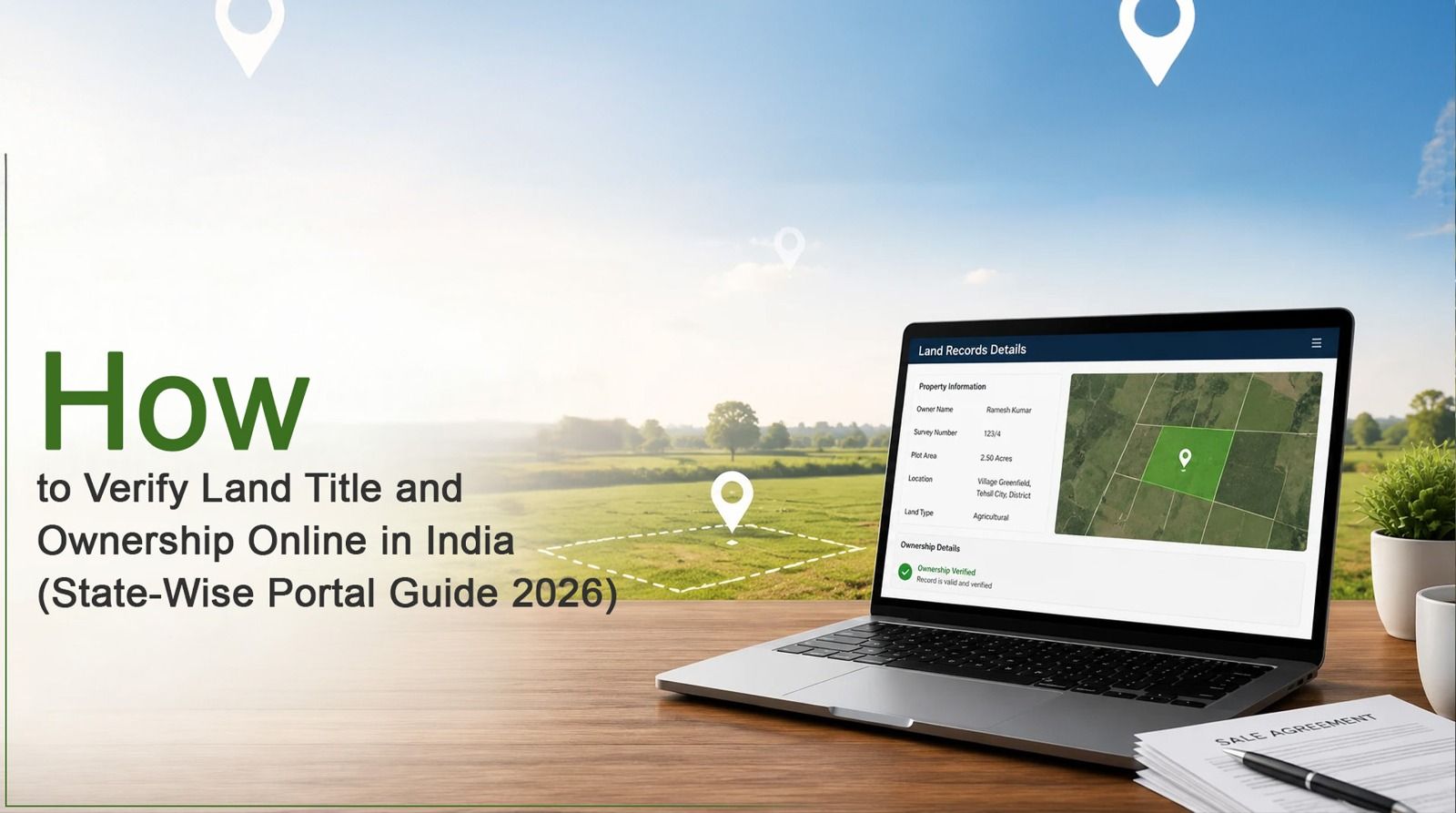
How to Verify Land Title and Ownership Online in India (State-Wise Portal Guide 2026)
Buying land is exciting.
It can also become one of the biggest financial mistakes if you skip one simple step—verifying who actually owns the property.
Many buyers spend weeks comparing locations, negotiating prices, and discussing home loans. Yet they forget to verify the legal ownership of the land until the very end. By then, problems often start appearing. A missing document, an old family dispute, an unpaid loan against the property, or even a fake seller can turn a dream investment into years of legal trouble.
The good news is that verifying land ownership has become much easier than it was a few years ago.
Today, almost every state in India offers online land record portals where buyers can check ownership details, survey numbers, mutation records, and several other important documents before making a payment.
If this is your first property purchase, don't worry.
This guide explains everything in simple language. We'll go through the complete process, common mistakes buyers make, documents you should verify, and the official portals available across different states.
A few minutes of verification today can save years of stress later.
Why Verifying Land Ownership Matters More Than Ever
Property fraud isn't something that only happens in movies.
Across India, buyers still lose money because they trust verbal promises instead of checking official records.
Sometimes the seller genuinely believes everything is fine. Later, the buyer discovers that the land was inherited by multiple family members, or there is an old court case that nobody mentioned.
In other situations, the seller may not even be the legal owner.
One common situation many property consultants talk about is this:
A buyer finds a plot at a surprisingly attractive price. Everything looks perfect. The location is developing quickly, and the seller insists that multiple buyers are interested. Feeling pressured, the buyer pays a token amount immediately.
A week later, while applying for a loan, the bank's legal verification reveals that the land has already been mortgaged.
The deal falls apart.
Getting the advance back becomes another battle.
Stories like these are more common than people think.
That is exactly why legal verification should always happen before paying the booking amount—not after.
What Does "Land Title" Actually Mean?
Many buyers confuse ownership with possession.
They're not always the same.
A land title is the legal proof that establishes who owns a property and has the legal right to sell, transfer, or mortgage it.
Someone may be living on the land for years, but that alone doesn't automatically make them the legal owner.
Similarly, paying property tax doesn't always prove ownership either.
A clear land title generally confirms:
The legal owner of the property
The ownership history
Rights to transfer or sell
Whether ownership is disputed
Whether government records match the documents
Think of it like checking the registration certificate before buying a second-hand car.
You wouldn't purchase a vehicle without verifying its papers.
Land deserves even more caution because the investment is much larger.
Documents You Should Verify Before Buying Any Land
Online records are incredibly useful.
However, they should never be the only thing you rely on.
Always cross-check the following documents.
1. Sale Deed
The Sale Deed is one of the most important legal documents.
It confirms that ownership has legally transferred from the previous owner to the current owner.
Check whether:
Seller's name matches government records
Property dimensions are correct
Survey number matches official records
Registration details are complete
2. Encumbrance Certificate (EC)
This document tells you whether the property has:
Outstanding loans
Legal liabilities
Mortgages
Court attachments
Previous registered transactions
Buying land without checking the Encumbrance Certificate is like buying a used car without asking whether the bank still owns it.
3. Mutation Records
Mutation records show whether ownership has been updated in the local revenue department after a sale or inheritance.
Sometimes buyers register a property but never complete mutation.
Later, revenue records continue showing the previous owner's name, creating unnecessary complications.
4. Property Tax Receipts
Ask for recent tax receipts.
Regular payment of taxes generally indicates that records are being maintained properly.
However, remember this carefully:
Property tax receipts support ownership records.
They do not replace legal ownership documents.
5. Approved Layout Plan
If you're purchasing a residential plot, verify whether the layout has received approval from the relevant development authority.
Unauthorized layouts can create serious legal issues later.
6. Identity Proof of the Seller
It sounds obvious.
Yet many buyers overlook it.
Ensure the seller's Aadhaar, PAN, or other identity documents match the name appearing on the registered Sale Deed.
Even small spelling differences should be clarified before proceeding.
Step-by-Step Guide to Verify Land Ownership Online
The process differs slightly across states, but the overall approach remains similar.
Here's how most buyers can verify ownership from home.
Step 1: Visit Your State's Official Land Records Portal
Every state maintains its own digital land records website.
We'll share the complete state-wise list later in this guide.
Always use official government websites.
Avoid unofficial portals that ask for unnecessary payments.
Step 2: Select Your District and Village
Most portals will ask you to choose:
District
Tehsil or Taluk
Village
Revenue Circle
Once selected, the system will display the available land records.
Step 3: Enter Available Property Details
Depending on the state, you'll usually search using one of these:
Survey Number
Khasra Number
Khata Number
Plot Number
Owner Name (available in some states)
If you don't know these details, ask the seller before proceeding.
A genuine seller usually shares them without hesitation.
If someone repeatedly avoids providing even the survey number, treat it as a warning sign.
Step 4: Verify Ownership Details
Carefully compare the online information with the documents provided by the seller.
Look for:
Owner's name
Survey number
Area
Village details
Property classification
Revenue records
Everything should match.
Even small inconsistencies deserve clarification.
Step 5: Download or Print the Record
Most state portals allow users to download or print a copy of the land record.
Save it for future reference.
If you're applying for a home loan, your legal advisor may also request these records during verification.
Can Online Land Records Alone Guarantee Safe Ownership?
The short answer is no.
Online records are extremely helpful, but they are only one part of the verification process.
Experienced property lawyers often recommend combining online verification with document verification and a legal title search.
For example, imagine two buyers looking at the same plot.
The first buyer checks only the online ownership record.
The second buyer checks the online record, reviews the Sale Deed, obtains the Encumbrance Certificate, verifies mutation records, and consults a property lawyer before making payment.
Both buyers spend nearly the same amount of time.
However, the second buyer significantly reduces the chances of future disputes.
When you're investing your savings, an extra layer of caution is always worth it.
A Small Reality Check
In recent years, digital land record systems have improved significantly across India, making property verification more transparent than ever before. At the same time, experts continue to advise buyers not to rely solely on screenshots or photocopies shared by sellers. Verifying records directly through the official government portal and matching them with original documents remains one of the safest approaches before finalising any land purchase.
If you're buying property for the first time, you may also find our guide on common mistakes home buyers make before purchasing property in India helpful before making your final decision.
Complete State-Wise Official Land Records Portals (2026)
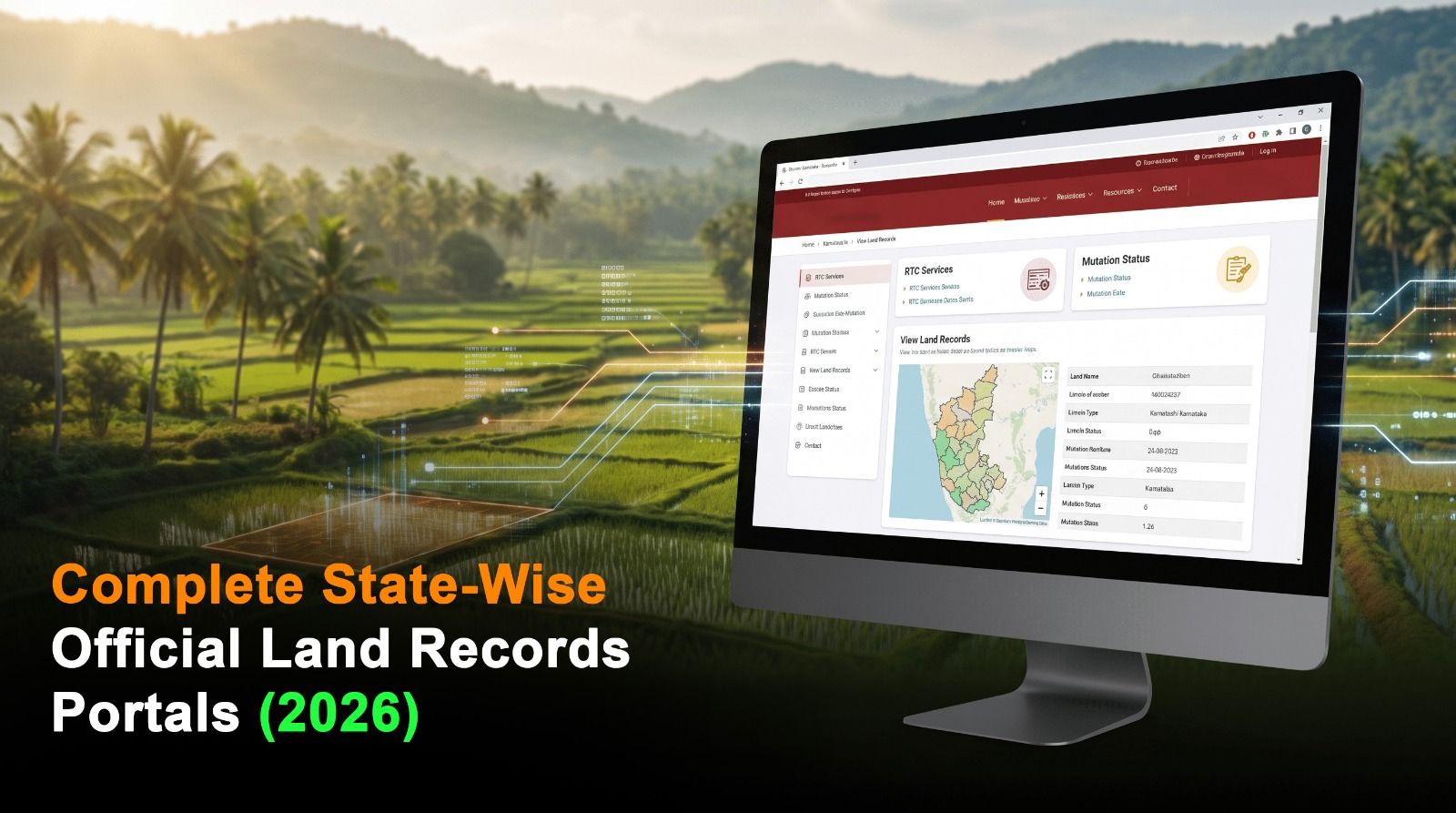
One of the biggest advantages for property buyers today is that most Indian states have digitised their land records. Instead of visiting multiple government offices, you can often verify basic ownership details from your home.
Here's a quick reference table of the major official land records portals.
State / UT | Official Portal | Records Available |
Andhra Pradesh | MeeBhoomi | Adangal, 1B Records |
Arunachal Pradesh | State Revenue Portal | Land Records |
Assam | Dharitree | Jamabandi, Mutation |
Bihar | Bihar Bhumi | Jamabandi, Khasra |
Chhattisgarh | Bhuiyan | Land Records |
Delhi | Delhi Revenue Department | Land Records |
Goa | Goa Land Records | Survey Details |
Gujarat | AnyRoR | Record of Rights |
Haryana | Jamabandi, Mutation | |
Himachal Pradesh | HimBhoomi | Land Records |
Jharkhand | JharBhoomi | Khatian |
Karnataka | Bhoomi | RTC, Mutation |
Kerala | e-Rekha | Survey Records |
Madhya Pradesh | MP Bhulekh | Land Records |
Maharashtra | Mahabhulekh | 7/12 Extract |
Odisha | Bhulekh Odisha | RoR |
Punjab | Punjab Jamabandi | Ownership Records |
Rajasthan | Apna Khata | Jamabandi |
Tamil Nadu | TN e-Services | Patta & Chitta |
Telangana | Dharani | Land Records |
Uttar Pradesh | UP Bhulekh | Khasra, Khatauni |
Uttarakhand | Devbhoomi | Land Records |
West Bengal | BanglarBhumi | RoR |
Tip: Always access records through the official government portal. Avoid third-party websites that charge for information that is freely available.
Red Flags That Should Never Be Ignored
Sometimes, buyers become emotionally attached to a property and overlook obvious warning signs.
That can be expensive.
Here are a few situations where you should pause the deal until everything is clarified.
1. The seller avoids sharing documents
A genuine owner usually has no hesitation in sharing copies of the Sale Deed, tax receipts, or survey details.
Repeated excuses deserve attention.
2. The ownership names don't match
If the online record shows one name while the Sale Deed shows another, ask why.
Sometimes there's a genuine explanation. Sometimes there isn't.
Never assume.
3. The property price seems unusually low
We've all heard the saying, "If it sounds too good to be true, it probably is."
The same applies to real estate.
An unusually cheap property often deserves deeper verification.
4. Multiple people claim ownership
Inherited properties frequently involve multiple legal heirs.
Ensure that every legal owner has agreed to the sale.
5. The property is under litigation
If there is an ongoing court case, seek legal advice before proceeding.
Waiting a little today is far better than fighting a legal battle for years.
How Banks Verify Property Before Approving a Home Loan
Many buyers believe that if a bank approves a home loan, everything must be legally perfect.
While banks conduct legal due diligence, their verification is primarily to protect their financial interest.
Typically, banks examine:
Sale Deed
Chain of ownership
Encumbrance Certificate
Approved layout
Property valuation
Legal opinion from empanelled advocates
Even then, it's wise to carry out your own independent checks.
Think of the bank's verification as an additional layer of confidence—not a substitute for your own due diligence.
A Small Story Every Buyer Can Relate To
A few months ago, a first-time buyer visited three different plots over two weekends.
The first looked attractive online but had an unresolved ownership issue.
The second had incomplete mutation records.
The third wasn't the cheapest, but every document matched perfectly.
Guess which one they bought?
The third.
Months later, while neighbours in the first project were dealing with legal notices, the buyer had already started construction.
That's the thing about property purchases.
Peace of mind rarely comes from getting the lowest price.
It comes from knowing you've done your homework.
Don't Forget These Offline Checks
Even in the digital era, a physical visit remains important.
Before finalising the deal:
Visit the property at different times of the day.
Speak with nearby residents.
Verify road access.
Confirm electricity and water availability.
Check whether the land boundaries match official records.
Ask whether there have been previous ownership disputes.
Local conversations often reveal details that documents don't.
Complete Land Verification Checklist
Before paying even the booking amount, ensure you've completed the following:
✅ Verified ownership online
✅ Checked the Sale Deed
✅ Examined the Encumbrance Certificate
✅ Confirmed mutation records
✅ Verified survey number
✅ Checked approved layout
✅ Reviewed tax receipts
✅ Verified seller identity
✅ Visited the property
✅ Consulted a property lawyer (recommended)
If every box is ticked, you're already ahead of many buyers.
Final Thoughts
Buying land is one of those decisions that stays with you for decades.
The location matters.
The price matters.
Future appreciation matters.
But none of these things matter if the ownership itself isn't clear.
Fortunately, verifying land ownership has become much easier than it was a decade ago. Government portals, digitised records, and online verification tools have made the process faster and more transparent.
Still, technology should support your decision—not replace your judgment.
Take your time.
Compare every document.
Ask questions.
And if something doesn't feel right, don't rush because someone says, "This deal will be gone tomorrow."
Another property will always come along.
Peace of mind is much harder to find.
Author Bio
Our editorial team publishes practical, research-backed guides on property buying, selling, land records, legal documentation, and real estate trends across India. Every article is written to simplify complex property topics so buyers can make informed decisions with greater confidence.
Founder's Note
Buying property isn't just a financial transaction—it's a life decision.
Our goal is to make reliable property information accessible to everyone, whether you're purchasing your first residential plot or planning your next investment. We believe informed buyers make better decisions, and every guide on this website is created with that purpose in mind.
Thank you for trusting us as part of your property journey.