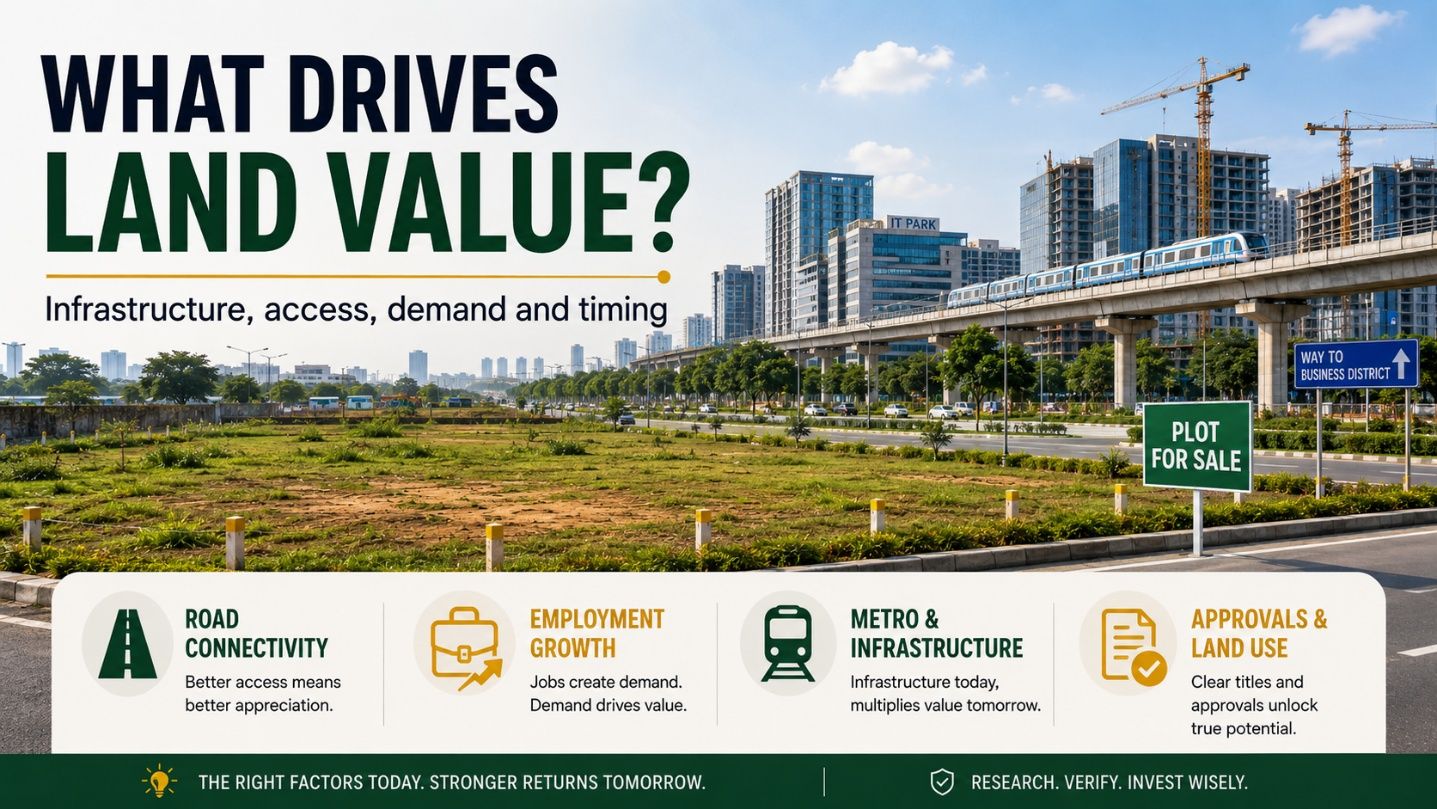
Is Vacant Land a Good Investment? The Answer Depends on What You Buy — and Why
Vacant land has a strange attraction.
There is no leaking roof. No tenant calling at 11 p.m. No lift maintenance. No kitchen to renovate before resale.
You buy a piece of land, hold it, and hope the city eventually grows towards you.
Simple.
At least, that is how it looks.
In reality, vacant land investment can be one of the most rewarding forms of property ownership — or one of the easiest ways to leave money sitting idle for years.
The difference usually comes down to four things: location, legal clarity, future use and the price paid at the beginning.
That last point deserves attention.
A good piece of land bought at an inflated price can still become a poor investment.
Meanwhile, an ordinary-looking plot bought before infrastructure and demand arrive can sometimes become surprisingly valuable.
So instead of asking only, “Is vacant land a good investment?”, ask a better question:
“What has to happen for this land to become more valuable than it is today?”
If you cannot answer that clearly, do not rush into the deal.
Why Vacant Land Attracts Investors
Land feels permanent.
Buildings age. Interiors become outdated. Mechanical systems need repairs. However, the land underneath them does not physically depreciate in the same way.
That makes vacant plots attractive to long-term investors.
Another advantage is flexibility.
Depending on zoning and approvals, land may eventually support a house, apartments, shops, warehousing, agriculture, hospitality or another commercial use.
But there is an important phrase there:
depending on approvals.
A plot is not automatically valuable because someone tells you that a highway, metro station or commercial hub is “coming nearby.”
The land must have a legal and practical use.
That distinction is where experienced buyers separate themselves from emotional buyers.
The Biggest Return Usually Comes From Change
Land generally does not produce a return merely because it exists.
Its value often increases because something around it changes.
Perhaps a new road improves access.
Maybe an industrial zone creates jobs.
A metro line could make the location easier to reach.
A new university, hospital, airport, logistics park or commercial district may increase nearby demand.
Sometimes the most valuable change is more basic: an area receives better roads, sewerage, electricity or planning approval.
This means a vacant land investor is often making an infrastructure and urban-development bet, not simply a property bet.
And timing matters.
Buying five years before development arrives can be rewarding.
Buying after everybody already knows the story may mean paying tomorrow's price today.
What Kind of Returns Can Vacant Land Give?
There is no responsible universal answer such as “land gives 15% annual returns.”
Land returns vary dramatically.
One plot can double because a major infrastructure project arrives nearby.
Another can remain nearly unchanged for ten years.
The sensible way to judge potential return is to ask what will create future demand.
For example, imagine a plot on the edge of a growing city.
Today, there are few houses nearby. However, a major road is under construction, residential projects are beginning to appear, and employment centres are gradually moving closer.
That land has a visible growth thesis.
Now compare it with a cheaper plot 40 kilometres away where no major employment, infrastructure or population growth is visible.
The second plot may cost less.
It is not automatically better value.
Cheap land can remain cheap for a very long time.
Appreciation Is Only Half the Return Story
Property advertisements usually focus on appreciation.
They rarely focus on time.
Suppose someone says:
“I bought this plot for ₹50 lakh and sold it for ₹80 lakh.”
That sounds impressive.
But was the land held for two years?
Or twelve?
Those are completely different investments.
Therefore, evaluate land using annualised return, not just the percentage increase between purchase and sale.
Also subtract acquisition costs, taxes, fencing, legal expenses, financing costs, brokerage and selling expenses before celebrating the profit.
The headline gain is not always the actual gain.
The Problem With Vacant Land: It Usually Doesn't Pay You While You Wait
This is perhaps the biggest difference between vacant land and a rented apartment.
An apartment can potentially produce monthly rent.
A commercial shop can generate lease income.
Vacant land often produces nothing.
Month after month.
Year after year.
Yet money remains locked in the asset.
This creates what investors call an opportunity cost.
If ₹1 crore sits in a plot for seven years, the investor should compare the final return with what that ₹1 crore could have produced elsewhere.
That does not make land a bad investment.
It simply means appreciation needs to justify the waiting period.
And that is often forgotten.
Holding Costs: The Expenses Nobody Talks About at the Site Visit
Land may look maintenance-free.
It isn't completely free to hold.
The exact costs depend on the state, municipality, type of land and ownership structure, but an investor may face expenses such as local taxes or levies, boundary maintenance, fencing, security, periodic site cleaning, legal work, survey expenses and travel to inspect the property.
If the property is financed, interest becomes another major holding cost.
Then there is paperwork.
Mutation records, ownership documents, survey boundaries and local authority records may require attention over time.
None of these expenses may look frightening individually.
Together, however, they reduce your real return.

The Quiet Risk: Encroachment
A vacant plot can be easier to ignore than an apartment.
That is exactly why ignoring it can become expensive.
If you live in another city—or another country—you may not visit the land frequently.
Six months becomes a year.
A boundary gets disturbed.
Someone starts using part of the property.
A neighbour disputes a line.
Then suddenly the “low-maintenance investment” requires lawyers, surveyors and repeated site visits.
Therefore, physical possession matters.
Clear boundary identification matters.
Periodic inspection matters.
If you cannot manage the property yourself, arrange reliable local supervision.
A cheap fence can sometimes protect a very expensive asset.
Title Risk Can Destroy an Otherwise Brilliant Investment
A beautiful location cannot compensate for defective ownership.
Before buying vacant land, verify the title chain.
Check whether the seller has the legal right to sell.
Review encumbrances.
Confirm survey numbers and physical boundaries.
Check applicable land-use and development rules.
Verify road access.
Also investigate whether litigation, acquisition notices, mortgages, easements or competing ownership claims exist.
For large transactions, independent legal due diligence is not an optional luxury.
It is part of the investment.
The cost of checking the title is tiny compared with the cost of discovering a problem after registration.
Road Access: The Detail Buyers Notice Too Late
Imagine buying a beautiful rectangular plot.
The price is excellent.
The neighbourhood looks promising.
Then you discover that the practical access road is disputed.
Or too narrow.
Or privately controlled.
Suddenly the value calculation changes.
This is why road access deserves almost the same attention as title.
Ask whether the access is recorded.
Measure the road width.
Check the development plan.
Confirm whether large vehicles can realistically reach the plot.
Future construction becomes much harder if the land is legally yours but practically difficult to enter.
Sounds obvious.
Yet this is exactly the kind of detail people miss when they fall in love with a location.
Land Use Can Change Everything
Not every plot can be used for every purpose.
Agricultural land, residential land, industrial land and commercial land can be governed differently.
Local planning rules may limit construction type, floor area, subdivision and access.
Therefore, never assume:
“We can convert it later.”
Maybe.
Maybe not.
A serious vacant land investment should have a realistic future-use case supported by applicable rules and planning documents.
Infrastructure rumours are not enough.
A Buyer Story That Explains Land Investing
Imagine two brothers buying land in the same district.
The first buys the cheaper plot.
It sits far inside a village road because the seller convinces him that a large development will arrive soon.
The second pays 20% more for land near an existing road, with clean access and visible residential growth.
Ten years later, development has reached both areas.
But buyers prefer the second plot.
Why?
Because access was never an issue.
Construction is easier.
The surrounding neighbourhood matured faster.
Finance is easier to arrange.
Resale is easier to explain.
The first brother technically bought cheaper land.
The second bought the better asset.
That difference matters.
What Makes a Strong Vacant Land Investment?
A strong plot usually has several things working together.
There is a clear legal title.
Access is practical.
The location has visible demand drivers.
Nearby population or employment is growing.
Infrastructure improvements are credible rather than purely speculative.
The permitted land use has commercial value.
And, most importantly, the investor did not overpay.
You do not need every advantage.
But you need enough of them.
A plot with no income, poor access, uncertain title and no obvious future user is not an investment thesis.
It is hope.
When Vacant Land Can Be Better Than an Apartment
Land can make sense for someone with a long investment horizon who does not need immediate monthly income.
It may also appeal to buyers who believe strongly in a specific growth corridor and are comfortable waiting for development.
Unlike buildings, there is no apartment interior becoming outdated while you wait.
There may also be opportunities to create value through subdivision, development, land-use changes or partnerships, subject to planning rules and approvals.
However, these opportunities require expertise.
They are not automatic.
When an Apartment May Be the Better Investment
An apartment may be better if you want regular rent.
It may also suit investors who prefer an asset that is easier to compare with similar transactions.
Financing can be simpler for standard residential property than for certain categories of land.
Management is also different.
With an apartment, you can inspect the building, society, occupancy and rent levels.
With undeveloped land, you are betting more heavily on what the location may become.
Neither approach is inherently superior.
They solve different investment problems.
The Tax Question in India
Tax should be considered before calculating your expected return.
Under current Indian income-tax guidance, immovable property such as land or buildings is generally treated as a long-term capital asset when held for more than 24 months. Current Income Tax Department guidance states that long-term capital gains are generally taxable at 12.5% without indexation; it also describes a special option for resident individuals and HUFs for certain land or buildings acquired before 23 July 2024. Tax treatment depends on individual circumstances, so investors should verify the applicable provisions with a qualified tax professional before selling.
This matters because the number that reaches your bank account after a sale is more important than the number appearing in the sale agreement.
Investment Advice: My Checklist Before Buying Land
Before paying even a token amount, I would answer these questions:
Who legally owns the property?
Is the entire title chain clear?
What is the exact survey or plot number?
Does the physical boundary match the paperwork?
Is access legally recorded?
What is the permitted land use?
Are any government acquisition or planning proposals affecting it?
What development is actually happening nearby—not merely promised?
What will it cost me every year to hold?
Who is likely to buy this land from me later?
That final question is especially useful.
A residential developer?
An individual home buyer?
An industrial company?
A farmer?
A warehouse operator?
Another investor?
If you cannot identify the likely future buyer, liquidity may be weaker than it first appears.
The Liquidity Problem
Land is not a fixed deposit.
You cannot always decide on Monday that you need cash and sell the asset by Friday.
Finding the right buyer can take time.
Price discovery can also be difficult because two plots only a few hundred metres apart may differ greatly in frontage, access, land use, shape and legal status.
So keep emergency money somewhere else.
Never assume vacant land will provide instant liquidity when you need it.
Is Vacant Land a Good Investment in 2026?
Yes—if you buy the right land for the right reason and can afford to wait.
Vacant land can be powerful because future infrastructure, population growth and changing land use can create significant value.
However, the absence of rental income means the investor must be patient.
Legal problems can be serious.
Holding costs reduce returns.
Liquidity may be limited.
And appreciation is never guaranteed.
So the best land investment is rarely the plot with the most exciting sales pitch.
It is the plot where you can clearly explain:
why people will want this land more five or ten years from now than they do today.
If that answer is supported by real roads, real demand, clean documents and a sensible purchase price, you may have something worth holding.
If the entire case depends on someone saying, “Sir, this area will boom,” keep looking.
Frequently Asked Questions
Is vacant land a good investment?
Vacant land can be a good long-term investment when it has clear title, practical access, strong future demand and a sensible entry price. However, it usually does not generate regular rental income, so appreciation needs to justify the holding period.
Does vacant land generate passive income?
Usually not by itself. Income may sometimes be generated by legally leasing land for parking, agriculture, storage, advertising, renewable-energy installations or other permitted uses, but this depends on location, zoning and local regulations.
What are the biggest risks of buying land?
Important risks include defective title, encroachment, unclear boundaries, poor access, unsuitable land use, government acquisition, weak liquidity, overpricing and development that takes much longer than expected.
What are the holding costs of vacant land?
Costs may include local taxes or levies, fencing, site maintenance, security, legal expenses, surveys, financing costs and periodic property management. The exact costs vary by location and property type.
Is land better than an apartment for investment?
Neither is always better. Land may offer stronger appreciation potential in certain growth corridors, while apartments can provide rental income and often have clearer comparable market prices.
How long should I hold vacant land?
There is no universal holding period. Land usually suits investors with a medium- to long-term horizon because infrastructure and neighbourhood development can take years.
Is vacant land taxable when sold in India?
Capital gains taxation can apply. Current Income Tax Department guidance generally treats land or buildings held for more than 24 months as long-term assets and states a general 12.5% LTCG rate, subject to specific rules and exceptions. Consult a tax professional for your transaction.